
|
Regional customs: Memorial boards
Following in the footsteps of our ancestors
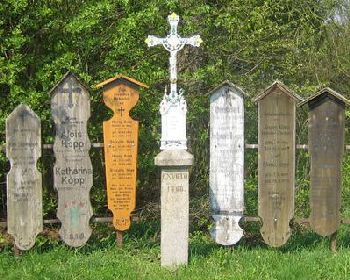
The tradition of memorial boards was widespread in Bavaria and the Alemannic region in the 19th century. It has also been documented in the Bohemian Forest in the Czech Republic. However, this old tradition of erecting memorial boards has now largely disappeared, except in a few places in southern Germany, particularly in eastern Bavaria and the Alpine foothills. In these areas, long, narrow boards bearing names, inscriptions and verses can occasionally still be seen standing by the roadside or grouped together in specific locations. These beautiful pieces often have a small canopy to protect the inscription from the elements.
These long boards are not used for laying out the body. Instead, they are memorial plaques erected in honour of the deceased. They were never used for this purpose. This tradition dates back to a time when coffin burials were uncommon in our culture. The body would be laid out in the house where the person had died, usually their own home. It would be placed on a long board, tied down, and carried to the grave.
Often, the body would be buried with the board, or the board would be slid gently into the grave. This process was called 'board sliding' and was also used as a euphemism for death and burial. The venerable death board was also aptly named the 'sliding board'. Unlike today, death was more integrated into life in centuries past, so this practice was not intended to be disrespectful.
The board, on which the deceased had lain, was sometimes burned, but was often kept for further use or erected as a memorial. This took place either in the deceased's yard or on a path that they had often walked. Often, this was the path to the church, which is why death boards were found in its immediate vicinity. Initially, the planks were not inscribed, but simply marked with three crosses. Over time, however, names, dates, and religious sayings were added, turning death boards into valuable sources of information for genealogical research, just like gravestones. Later on, the wooden boards were also decorated with paintings.
If you are lucky enough to find a well-preserved memorial board, you can avoid the tedious task of searching through old church or office archives. Although memorial boards are not erected very often nowadays, those that remain are carefully maintained, and inscriptions are renewed if necessary. Old death boards that were actually in use are rarely found in good condition. This is mainly because the boards were deliberately made of easily perishable wood.
There were many superstitions surrounding the final resting place of the dead before burial. It was widely believed that the soul of the deceased had to remain in purgatory until the board on which it had lain had rotted or the writing had become illegible.
Those who cared about the deceased's soul would ensure that wind and weather could do their work quickly and undisturbed. There are reports of death boards being used as footbridges or stepping boards, not out of disrespect, but to ensure they wore out quickly. This practice continued even after coffins became the norm, with death boards still being used to carry the deceased to their graves. Narrower, shorter boards bearing the dates of death were often erected in memory, as a kind of homage to the earlier custom.
Interestingly, the erection of death boards, which were strongly associated with superstition, was banned during the Enlightenment. Despite this, the bier board tradition continued until the period before the First World War.
The inscriptions on old memorial plaques can provide valuable information for those dedicated to genealogical research and searching for traces of their ancestors. Fragile wooden archives once lined the paths, but they are becoming increasingly rare and the information they contained is fading with them.
© 'Regional customs: Memorial boards. Following in the footsteps of our ancestors': An article by Pressenet (translated by Izabel Comati), 12/2025. Image credit: A group of memorial boards on the Calvary of Regen. Author/photographer: Papiermond, Creative Commons Licence.
– A new day begins for Julia (Short story)
– Flowers for Tom! Maybe there's more than one miracle
– A hellish trip to the dead planet (Science fiction)
Discover more articles! Use the search function:
English archive:
More reviews, book presentations and essays
2024/2025
German archive:
2025 |
2024 |
2023 |
2022 |
2021 |
2020 |
2019 |
2018 |
2017 |
2016 |
2015 |
2014 |
2013 |
2012 |
2011 |
2010 |
2009
Become a writer for Pressenet! Write articles for our online magazine on trending topics such as best books to read, health and wellness, technology and gadgets, business and finance, travel and tourism, lifestyle and fashion or education and career. Info: Become an author
Sponsors and investors are welcome: If you found our articles interesting, we would be grateful for a donation. Please also recommend us to your networks. Thank you very much!




Sitemap About Privacy Policy RSS Feed