
|
Grassner and the act of creation
Hell is paradise in abundance (a short story by Ilona E. Schwartz)
It was Lothar Grassner's first day out in the fresh air, his first, somewhat unsteady, walk in fourteen days. The illness had hit him hard, with all its full force. Headaches, a cold, a fever – the whole shebang. Grassner lived alone, and had assured the sceptical doctor that his sister would check on him daily. What he didn't mention was that Mara lived far away, practically at the other end of the country, and only occasionally asked about his well-being by email. He simply couldn't be bothered to go to hospital. He dreaded hospitals.
Then, for a few days, things took a turn for the worse. He took his medication as best he could and drank mineral water. He hadn't had much of an appetite anyway. But that had passed, and he'd managed to talk the doctor out of arranging another home visit over the phone. Grassner had made an appointment, so perhaps he would go after all.
Grassner would never have believed that he would miss the neighbourhood. He certainly wasn't one for company, yet he was now enjoying the mild autumn light and the earthy colours of the trees. He even felt pleasantly moved by the sight of the people around him. Normally, Grassner avoided overly close contact with his neighbours. He considered brief, albeit friendly, greetings to be entirely sufficient, and this approach had always served him well. He was a loner; he always had been. It wasn't that he disliked people, he just didn't find them particularly interesting. However, after spending so many years in this neighbourhood, it was inevitable that the people here would become familiar to him. Since he had never observed them at close quarters, but only from a distance, he understood a surprising amount of what he saw. This is why Grassner immediately realised that something wasn't quite right. It was different from how it should be – just a shade different, but noticeable.
Back home, he wondered if his queasy and vaguely anxious feelings during his walk might have been due to the illness he had just recovered from. But he resolved to be very observant on his next stroll. Apart from being a loner, Grassner also possessed a fair bit of a detective's instinct, so he went out again the very next day. When he had finished this very long walk, he was left with a host of questions.

Strange people were pacing back and forth in front of the Richter family's house. Blokes in dark clothing who would occasionally glance at the facade and front door out of the corner of their eyes. They were the kind of men you see portrayed as crooks and burglars in poorly made pseudo-realistic films. It looked strangely staged, mainly because these figures could only be seen in front of the Richters' property and nowhere else in the neighbourhood. Admittedly, Alfons Richter was particularly obsessed with an almost ridiculous fear of burglars – it was well known that he changed all the locks every quarter and that all the windows were lockable. People used to poke fun at him, as there was hardly any wealth to be found in that little house.
Now, strangely enough, it seemed that the Richters' fears might not have been so far-fetched after all. But something didn't add up – it looked as though these shady characters had been ordered to patrol the Richters' corner house. Grassner wondered if someone was playing a prank at the expense of good old Alfons – after all, he had annoyed his neighbours with his burglar phobia for years. But who would want to stage something like that? He couldn't think of anyone.
Then there was the smell coming from old Mrs Tomasik's house. Her front garden had a rather pungent odour of – well – faeces. Grassner was occasionally amused by the nagging old woman who, on his walks, called down all the punishments of heaven upon the neighbourhood's cats for defecating in her carefully tended flowerbeds. She was the terror of her neighbours, because she had no qualms about stopping passers-by and telling them off about their cats, whether they actually owned any or not.
But now, it seemed as though the old woman might actually be right. Grassner wondered why the smell hung like a bell over the Tomasiks' front garden and appeared to have concentrated there. As soon as you passed the seven or eight metres of picket fence, all you could smell was wild roses and, of course, exhaust fumes. Just as it was before the little fence. It was a mystery. It was indeed hard to imagine that all the neighbourhood cats were waging a vendetta against their old adversary by only doing their business in the Tomasiks' tulips. Or perhaps a cat lover had finally lost patience and tipped a load of the foul-smelling stuff over the neat picket fence during the night? Grassner doubted it.
Usually, the world was something that Lothar Grassner simply accepted as a given. In the same way, he accepted his fellow human beings without concerning himself too much with them – he took things as they came. He never passed judgement; he left that to others. It was not in his nature to evaluate other people's views and opinions. His attitude was one of acceptance, without being fixed on any particular view of things. This may well be precisely why he was the only one to have noticed these irregularities. Grassner believed that the men outside the Richters' house hadn't caught anyone's eye. He had been watching the passers-by, who didn't spare a glance for the strangers, despite them being quite conspicuous. That wasn't the sort of thing people in the neighbourhood did. He was reluctant to mention this to anyone, which was why he didn't know why seemingly no one had noticed the smell coming from the fenced-off cat litter tray. Not a single passer-by looked over or wrinkled their nose, even though the stench was now bringing tears to one's eyes.
The fact that Mr Semmet's flat upstairs was constantly visited by a large number of doctors who made house calls was another matter entirely. Of course, anyone could fall ill – that was simply something that happened. This was especially true in Semmet's case, as he knew of no other topic of conversation than his ailments and infirmities. He entertained customers in the bakery, people waiting at the bus stop, and anyone who made the mistake of striking up a conversation with him with his detailed descriptions. Admittedly, Mr Semmet gave the impression of being perfectly healthy, even athletic, but you could never tell – Grassner hadn't seen him for a long time. This matter only occupied his thoughts marginally, as he had seen far stranger things during his recent walks.
There was the postman, for example, who had delivered mail in the neighbourhood for years and always railed against 'young people' with true passion. He believed that the younger generation had no respect or any other sense of social decency, and that today's youth should be taken into custody as a preventive measure. As far as Grassner knew, the postman was a widower with no children, yet he was extremely critical of anyone under the age of twenty-one. The last few times Grassner had seen the postman, he had been in unsavoury company. On one occasion, a group of children skipped alongside him, teasing him about his splendidly shiny bald head. On another occasion, a group of teenagers stood on the pavement with their hands in their pockets, blocking the postman's way. As he forced his way through, swearing loudly, the lads kicked the wheels of his cart and spat at him.
Grassner wasn't really surprised that nobody stepped in or intervened. People walked past the postman and the teenagers as if nothing were amiss. It really did look as though nobody was actually noticing what was going on. Grassner watched closely, but there was no real need to intervene – apart from the postman's dignity, nothing was damaged or harmed. After all, the postman was never seen without a group of grinning, slightly jostling youths following him down entire streets.
But had it always been that way? Lothar Grassner thought about it and realised that he no longer knew for sure. His attention was then drawn to Mrs Graffmann. She lived one street away and, in her own way, also entertained those around her, albeit differently to Mr Semmet or the postman. She generously dispensed advice, whether she was asked for it or not, and she did so in a pleasant and humorous way. In her view, constant rain was good for the fruit, children were sweet and innocent, neighbours were the best people among a fundamentally kind population, crime only happened in films, and sunshine always followed bad weather quickly. She denied everything negative, even when it affected her personally. Above all, she felt pity for wayward people and had a thousand excuses at the ready. Mrs Graffmann also saw a completely empty glass as one that was about to be filled to the brim.
Grassner was amazed to see that there was always someone offering help. A neighbour would mow the lawn whenever Mrs Graffmann was plagued by rheumatism – something she made light of – and outside the supermarket, there was always a young person to help her stow the bags in the car. As she was no longer the youngest and her husband had difficulty walking, the section of pavement outside her house was always cleared of snow in winter, 'since they were doing it anyway'.
Mrs Graffmann lived in her own bright world, thought Lothar Grassner, where kindness and a willingness to help reigned supreme. This thought lingered at the back of his mind, refusing to fade, and suddenly became more than that. It was the solution, even if that might seem unbelievable. But Grassner's detached way of viewing things and his natural impartiality made it clear to him.
Of course, the Richters had summoned those shady characters themselves. They were the reality the couple had created for themselves. They lived in the world they wanted to live in. In their world, burglars were out to steal people's savings. Or the television, the fine porcelain, and the safety of their other possessions. Semmet lived in a universe of illness. He was not healthy enough to enjoy life, which frightened him. As for the postman, he was probably happier with the snotty-nosed brats who bullied him than without them, because they reinforced his hatred of all things young, pure and untamed. Everyone lived in the world they had created for themselves, and no one realised it. Except, perhaps, Mrs Graffmann, whose favourite saying was, after all, 'What goes around comes around'.
Grassner had always regarded these New Age types with mild astonishment. Among other things, they preached something similar. There were also a few passages in the Bible that could be interpreted in that way. In fact, they were all right. An infinite number of worlds existed side by side, sometimes touching one another yet remaining solitary. Grassner knew why he could see it: it was due to his way of perceiving things – his almost entirely objective view. Finally, the possibilities dawned on him. He simply had to choose a life – one of countless others that he could tailor to his own specifications. These thoughts made his head spin. He would have to explore himself to know what to wish for, committing to the conscious act of creation.
As this realisation became a certainty, Grassner took a step back to get a better view. He told himself that this chalice had passed him by. For him, it would be enough to contemplate the surrounding universes from the perspective of someone for whom nothing seemed more precious than an unobstructed view of the whole. Lothar Grassner rejected the deceptive paradise because it seemed too close to hell.
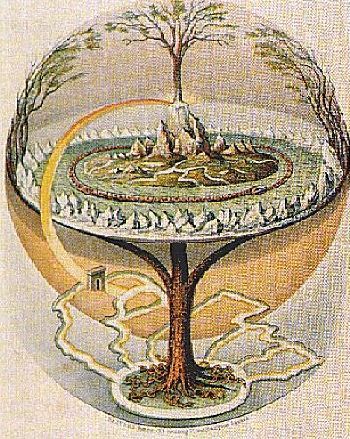
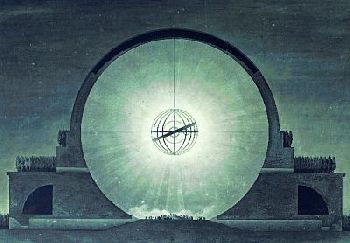
© 'Grassner and the act of creation. Hell is paradise in abundance': a short story by Ilona E. Schwartz (translated by Izabel Comati), 07/2026. Image credits: (Usage: public domain), top: Yggdrasil, the World Tree (illustrated by Oluf Olufsen Bagge, 1847); bottom: Cenotaph, the sphere symbolising the universe (designed by the architect Étienne-Louis Boullée, 1784).
– Snake days (The deception of warm weather)
– The mountain lionesses' and their journey to freedom
– Megachiroptera and the warning signs of the times
Discover more articles! Use the search function:
English archive:
More reviews, book presentations and essays
2024/2025
German archive:
2025 |
2024 |
2023 |
2022 |
2021 |
2020 |
2019 |
2018 |
2017 |
2016 |
2015 |
2014 |
2013 |
2012 |
2011 |
2010 |
2009
Become a writer for Pressenet! Write articles for our online magazine on trending topics such as best books to read, health and wellness, technology and gadgets, business and finance, travel and tourism, lifestyle and fashion or education and career. Info: Become an author
Sponsors and investors are welcome: If you found our articles interesting, we would be grateful for a donation. Please also recommend us to your networks. Thank you very much!






Sitemap About Privacy Policy RSS Feed