
|
The dancing little horse
A short story by Ilona E. Schwartz
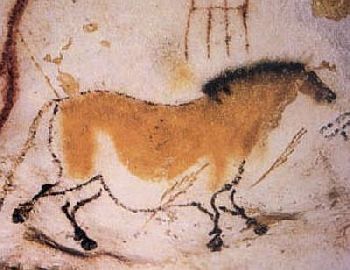
The little girl watched in amazement as the old man carefully poured coloured powder into a hollow. He had spent quite some time grinding things that the girl recognised into powder. These were things that grew outside, and ordinary stones that she wouldn't normally have paid any attention to. He could do quite marvellous things with them. He would throw a bit onto the wall and make it so that the child could look at it for a long time. All of those marvellous creatures, which were perhaps somewhat strange, were quiet and allowed people to speak loudly and look at them for as long as they liked. She was allowed to watch him do it and was delighted.
The large, horned animals moved across the wall, just as they did outside when the sun rose. They had their young with them, which was marvellous, because usually only hunters got to see that. Her mother had told her how the large, horned animals migrated with their young. When her mother still went hunting herself, she had seen it. But that was – here the child's thoughts faltered slightly – a very long time ago. Perhaps it had taken as long as it took for it to get warm enough outside to splash her feet in the shallow water at the river's edge, when the nasty ice made the entrance to the great cave small and narrow.
The old man traced round shapes on the wall with his fingers, like the pebbles in the stream. 'They were snowflakes', he said. 'But they were different. They weren't cold, and you didn't need to be afraid of them.' He also said that the ice wasn't evil, and that it had to be that way. Only what sleeps when everything is frozen can wake up again.
'But we're not asleep either, are we? We're awake, and we're doing everything we usually do', said the girl. The old man smiled to himself as he gently traced the hairs of the great horned beast onto the wall with a frayed wooden stick. 'Are we really doing everything just as we usually do?', he asked.
The child thought for a moment. 'No, not everything. We're not gathering anything, and we don't have much to eat. Just the old stuff we've got in the pits and in the big baskets. We're not allowed out, only the hunters and the women who go to fetch snow to make water from it. The stream down the slope is asleep, too. But I want it to stop.'
The old man laughed, took some red powder, moistened it, and suddenly there was a sun on the wall. All the animals that the old man had painted ran towards it. The red was so beautiful that the girl clapped her hands. 'I want to see that, too. I want to see the big horns and their young looking for the sun. Just like my mother. But then I want to bring them here, just as you do.'
'Yes', nodded the old man. 'She was a good hunter, the one who gave birth to you. She certainly brought her fair share of meat. But then the little ones came along, and the doe stayed with the herd.' He laughed softly again, thinking of the child of his mate, the mother of this girl. He had been very proud of her, and still was. She was clever, and she was strong. This little girl reminded him of her, of how she had been when she had seen about as many moons. Except this child could see what he was really doing. She was patient, and could wait for the images to appear.
Children belonged to the womb that had been her gateway to life. The man was aware of his part in creating new life, but he saw it as part of the woman. Yet, in this little girl, he recognised the same curiosity that had led him to do what he had been doing for so long. This required a curiosity that went beyond the essential knowledge needed to procure food. Some hunters saw more, others less.
He had seen a great deal, and displayed it so that the world might remain as full as it should be. His art offered hope for what lay beyond, for what would come after the last fire had burnt out. Some things happened time and again. They were part of the world he knew. The paths of the animals and the cycles of the plants were more than just sources of food. He felt it. It was a certainty. Just for the sake of the little girl's sparkling eyes, he used his skilled fingers to make a young horse roll over and play.
The rich ochre he used for this even seemed to glow in the pale sunlight that suddenly streamed through a crevice in the rock above. The animal seemed to come to life. The child was beside herself with joy, leaping up to embrace the old man in her thin arms.
He knew this little horse would not be there for long. The light-coloured paint would become damp through the crevice and would not withstand the powerful sunlight. But he could make a new one for the child. Or – and this thought felt like the promise of summer to him – she might do it herself.
Many ages later, researchers stood in the cave and marvelled at the pictures on the rock faces. 'Very easy to identify, very well preserved. Do you see that picture over there? It seems to consist of many layers. The puzzling thing is that it stands out from the other drawings in an astonishing way. It's as if the little horse is dancing!'
© 'The dancing little horse': A short story by Ilona E. Schwartz (translated by Izabel Comati), 10/2026. The illustration shows a detail from the Lascaux cave paintings. Licence: public domain.
– Urgently wanted: night-time nanny! Generous pay!
– With all the heart's blood and total dedication
– The Legends of Leij. A fantasy novel by Alexander Sandmann
Discover more articles! Use the search function:
English archive:
More reviews, book presentations and essays
2024/2025
German archive:
2025 |
2024 |
2023 |
2022 |
2021 |
2020 |
2019 |
2018 |
2017 |
2016 |
2015 |
2014 |
2013 |
2012 |
2011 |
2010 |
2009
Become a writer for Pressenet! Write articles for our online magazine on trending topics such as best books to read, health and wellness, technology and gadgets, business and finance, travel and tourism, lifestyle and fashion or education and career. Info: Become an author
Sponsors and investors are welcome: If you found our articles interesting, we would be grateful for a donation. Please also recommend us to your networks. Thank you very much!

Sitemap About Privacy Policy RSS Feed