
|
Shellac and the freedom of music!
Isn't music something wonderful?
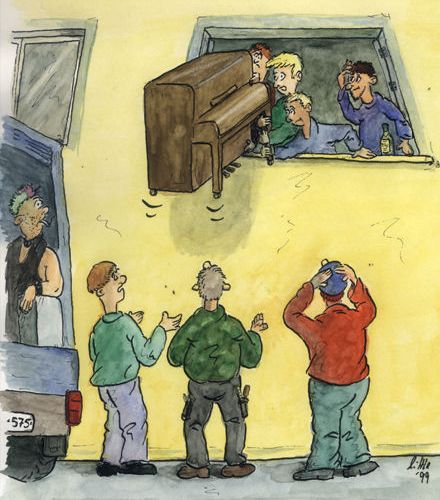
Almost everyone loves music, and it's something wonderful. Thanks to resourceful minds, we can enjoy music as often as we want. Imagine a world without sound recordings, where music could only be enjoyed live. People who play an instrument would be highly valued. Wouldn't it be hard for our spoilt generation to imagine that?
We are used to hearing music, or something similar, coming from almost every window, originating from some kind of recording. Supermarkets bombard us with it, and every other car blares out the groove. However, this has less to do with the category of 'music lovers' and more to do with incomprehensible urban rituals. At least it gives us an idea of what's in the charts at the moment. The fact that young people are becoming less and less responsive is not, anymore, largely due to generational conflict, but to those tiny earphones attached to equally tiny devices that can store an incredible amount of music. In fact, the environment in terms of the listening experience has changed rapidly and often over the last hundred years.
With the invention of the gramophone in the 1880s, music could be heard everywhere, not just in concert halls, at folk festivals or from street musicians. Wherever there was no domestic music, silence reigned in private spaces. However, this changed with the advent of the gramophone record, which was initially made of shellac. These discs achieved something unprecedented: you could take the music home with you and listen to it as often as you wanted.

The brittle shellac discs required extremely careful handling, but this was only natural given the cost of the initial discs and players. From the mid-1950s onwards, these fragile discs were replaced by vinyl ones, which quickly became mass-produced goods. Although they could scratch and were sensitive to heat, they were much easier to care for than their predecessors.
Record shops sprang up like mushrooms and every department store had a large record section. Above all, the whole thing became more portable, as small record players emerged that could be taken on the go. Large music cabinets gradually disappeared, making way for stereo systems with all the trimmings. For many young people, these systems became a kind of home altar, and they would spend hours searching for the 'sweet spot' (the point at which the speakers are optimally positioned to produce the ultimate stereo sound). For some stereo enthusiasts, the music itself became secondary.
In addition to records, a good tape recorder was also essential at the time. This allowed you to listen to music for hours without having to change the needle or use a record changer.
Guys no longer invited girls over to show off their stamp collection – now it was all about the Beatles and everything else that was 'on everyone's lips'. Then, in the 1960s, something new came onto the market: the music cassette. This little reel-to-reel device was supposed to be an improvement, because you didn't need needles to play it, nor did you need as much space to store your collection. In fact, these new sound carriers hit the market like a new Rolling Stones album and began to replace vinyl records. However, they had their quirks, because they were not indestructible. Tape jams were a frequent occurrence which often ruined the cassette.
Cassette recorders were reasonably priced and also available as standalone devices. However, stereo systems were no longer equipped with record players, but with these recorders instead. In addition, the systems became smaller. The once dominant speaker box, a status symbol, shrank to a more manageable size and no longer dominated the living room. But that's just a side note.
The real advantage of small magnetic tapes was that you could copy them yourself. Many cassette decks had two players, which was useful for making copies. You could also record music from the radio and create your own 'handmade' mixes. However, it was always advisable to have a pencil handy in case you needed to rewind manually when the recorder refused to work.
Once we had got used to these small rectangular items, CDs appeared around 1980 – and that was that. They were relatively durable, inexpensive and space-saving, unlike any other sound carrier before them. They could be played on a computer or disc player, used anywhere and copied. Portable devices were, of course, also available very quickly, as with almost all predecessors. While we are still praising the advantages of these little discs, much smaller devices with enormous storage capacity for music and even video have long been on the market and in every pocket.
Today, music is everywhere. This is in stark contrast to past centuries, when only the wealthy and powerful could enjoy music, and ordinary people would consider a small concert on a special occasion to be an extraordinary experience. In small settlements, perhaps people would look forward all year to the fairs, when musicians would perform and people would dance.
Thankfully, music is now available to everyone, so no one has to go without it. The only thing that perhaps dampens the joy a little is the fact that you don't hear many people playing music in the streets anymore – and even then, only if they have a permit in their pocket.
© 'Shellac and the freedom of music! Isn't music something wonderful?': An article by Pressenet (translated by Izabel Comati), 01/2026. Image credit: Thomas Alwin Müller, littleART.
– 18 January is World Snowman Day!
– Late beauties: Autumn crocus, Goldenrod and Wolfsbane
– Cards of the Major Arcana: Death, Temperance & The Devil
Discover more articles! Use the search function:
English archive:
More reviews, book presentations and essays
2024/2025
German archive:
2025 |
2024 |
2023 |
2022 |
2021 |
2020 |
2019 |
2018 |
2017 |
2016 |
2015 |
2014 |
2013 |
2012 |
2011 |
2010 |
2009
Become a writer for Pressenet! Write articles for our online magazine on trending topics such as best books to read, health and wellness, technology and gadgets, business and finance, travel and tourism, lifestyle and fashion or education and career. Info: Become an author
Sponsors and investors are welcome: If you found our articles interesting, we would be grateful for a donation. Please also recommend us to your networks. Thank you very much!




Sitemap About Privacy Policy RSS Feed