
|
'The Milkman Cometh': A Satirical Memoir
Book presentation: The true stories of Dux Loquax
'How on earth did I end up in this mess?', wonders Dux Loquax, author of true stories reflecting his real-life experiences.
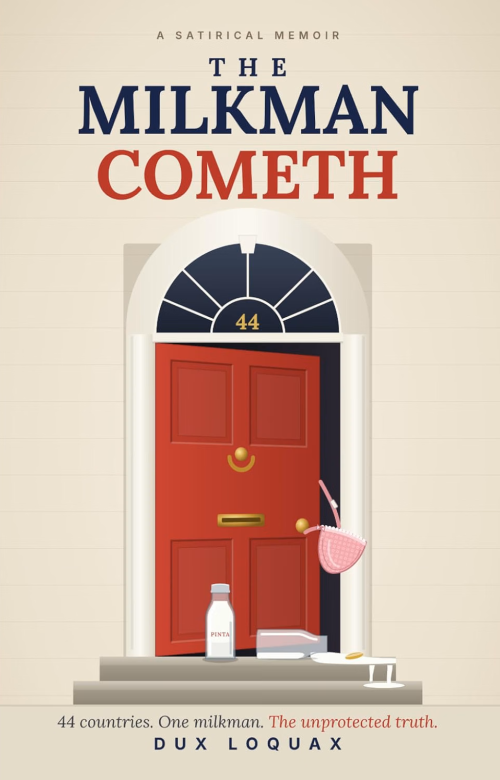
In his satirical anecdotes, Dux Loquax recounts tales from the business world, where contracts were sometimes more important than common sense, and where the next disaster rarely made it onto the agenda. (Diesen Beitrag in Deutsch lesen: 'Der Milchmann ist da')
Dux Loquax is a man who just wanted to do his job. Forty-four countries. Different cultures. Success and failure. Luxury and poverty. People you never forget. Landing in a small aeroplane in the Paraguayan jungle. Having a pistol pressed against his stomach in Nigeria. A twelve-cylinder engine in China. A rat in Mexico. And two cans of spray cream that turned a German export manager into an unwitting star in Moscow.
And somewhere in the middle of it all, a German milkman trying to conduct international business with a reasonable degree of dignity. With humour, sarcasm, and a healthy dose of self-deprecation, Dux Loquax recounts his experiences of international business trips and unusual business partners, and situations where common sense occasionally takes a back seat.
Before presenting two excerpts, Dux Loquax would like to share a few personal thoughts.
I have selected two chapters that illustrate my book's message in very different ways.
I am who I am. – This short sentence at the end of my foreword means far more to me than just a casual remark. It sums up the whole idea behind my book. All of the stories are drawn from my own life, based on encounters, experiences and situations that I have lived through and that have stayed with me for many years.
I deliberately chose not to write a book that follows a specific literary formula or tries to please every reader. Rather than being artificially perfect, I wanted it to be lively, personal and authentic. After all, real life doesn't follow any pre-written scripts. It is sometimes wonderful, sometimes absurd, sometimes uncomfortable, and occasionally even painful.
I recount these experiences with humour, self-deprecation, and respect for others. I don't want to expose or lecture anyone. I just want to let the reader share in my experiences.
Perhaps one story will make them laugh, another will make them shake their head, and another will give them food for thought.
I tell the story. The reader judges.
Our reading recommendation: (external links) 'The Milkman Cometh: A Satirical Memoir' comprises around 420 pages in both paperback and hardback editions, and was published in November 2026.
A special feature: In addition to the e-book edition, this book is also available in German, French, Italian, Spanish, Portuguese, Polish and Japanese on Dux Loquax's author profile.
Excerpt from chapter 10: Living Meat
'I would like living meat.'
I looked at the man.
He looked at me.
'Living meat?'
'Yes.'
I was twenty-seven, head of export at Kai Milch and not long in a position where business had stopped being counted in pallets.
One thought in shiploads.
I had trained as a dairy technician.
Milk, I could do.
Cream, too.
Condensed milk, certainly.
Living meat had not featured in my apprenticeship.
The man sitting in front of me mattered to our Libyan business. The volumes involved were bought in from various dairies across Germany. Entire shiploads of condensed milk went to Libya.
And this man was one of those whose approval counted.
Now he wanted living meat.
At first I tried to solve the problem on a technical level.
Raw meat?
Steak tartare?
Lamb?
Perhaps some speciality I didn't know?
In exporting you learn fairly quickly that the world is under no obligation to conform to your expectations.
So I asked.
'Living meat.'
Eventually the penny dropped.
He didn't want an animal.
He wanted a woman.
More precisely, he wanted to go where one could visit women in exchange for money.
That at least settled the fact that we weren't looking for a restaurant.
The real problem was only just beginning.
There are situations in working life for which no job description exists.
No seminar.
No organisation chart.
And almost certainly no handbook for heads of export.
I rang Mr Waldner.
It was late.
Mr Waldner was my boss and, later, one of my most important mentors.
I explained the situation.
Cologne was where our important Libyan partner wished to go.
To the Pascha, to be exact – the city's famous house of pleasure.
And he needed money.
At the time I had an American Express Platinum card.
Of which I was probably still a little proud.
Unlimited credit.
And I paid a great deal of money for that card.
Today I think:
Good grief.
That's how daft I was.
But that evening at least showed what a Platinum card could be good for.
It enabled a twenty-seven-year-old head of export to lay his hands on 400 Deutschmarks for a highly specialised customer request.
So I drew out the 400 marks on my Amex.
Then off to Cologne.
To the Pascha.
The man was given his money and disappeared inside.
I didn't.
I sat down across the road.
Chips.
A Coke.
And wait.
An hour can be long.
Two hours can be very long.
Especially when you know fairly precisely what you're waiting for.
I sat there with my chips and my Coke and had ample time to review my career to date.
Dairy technician.
Export logistics.
Head of export.
Condensed milk.
Shiploads.
The Pascha.
A perfectly logical career progression, really.
It's just that nobody had told me beforehand.
The chips went cold.
The Coke went warm.
I stayed put.
After about two hours the door of the Pascha opened again.
Our guest emerged.
Sweaty.
Not slightly warm.
Properly sweaty.
And grinning from ear to ear.
I looked at him.
He looked at me.
Questions were superfluous.
What had happened in those two hours, I didn't know.
And it was none of my business.
But to judge by his expression, he had got what he understood by 'living meat'.
He was happy.
I had cold chips.
Customer care comes in many forms.
And that concluded the evening.
Almost.
Because the 400 marks had gone through my American Express.
I naturally had no receipt.
So I had to write a substitute voucher.
Purpose of expenditure:
Customer care.
That is exactly what I wrote.
Customer care.
Sometimes the German language is astonishingly accommodating.
What was then reclaimed was precisely what had been spent.
No more.
No less.
And so 'living meat' ultimately became a properly recorded business transaction.
For the accounts department, at least.
Some time later, Libya was back in touch.
This time there was nothing to laugh about.
A big shipment of condensed milk had been at sea, bound for Libya.
As I remember, a hatch hadn't closed properly. The ship ran into bad weather.
Seawater got in.
Seawater has one decisive drawback where condensed milk is concerned:
It isn't an ingredient.
The damage was enormous.
It wasn't only our goods that were affected. Several companies were caught up in it.
Goods.
Insurance.
Liability.
Money.
And at some point came the question that crops up with astonishing reliability whenever there is major damage:
Who's going out there?
Enthusiasm was limited.
Libya at the time was not the sort of destination where colleagues spontaneously put up their hands and asked whether they might tack on the weekend.
In the end, I went.
We were to inspect the damage.
And we had a second assignment.
One that would stay with me far longer.
*
We were on the first Lufthansa flight permitted to fly to Libya again after the sanctions were lifted.
An auditor had been out there some three months earlier.
Now it was our turn.
At the hotel I stopped in my tracks.
Not because of my room.
Because of a display case.
It stood in the lobby.
An enormous glass cabinet.
Three or four metres long, as I remember.
And it was empty.
Almost.
Right in the middle lay a single book.
Nothing else.
Four metres of glass.
One book.
Green.
Gaddafi's Green Book.
I went closer.
A cabinet of that size normally calls for contents.
Watches.
Jewellery.
Porcelain.
Something.
Here lay a book.
In the middle of a great deal of nothing.
I couldn't help thinking of the old East Germany.
Of large spaces.
Large shelves.
And little on them.
That was my association at the time.
Perhaps it was unfair.
Perhaps not.
But the image was there.
And it stayed.
Three decades later I can't tell you what stood to the right of that cabinet.
I can't tell you what colour the carpet was.
But I can still see that cabinet.
And that one green book.
*
The next day we went to the warehouse.
It was huge.
We had come to Libya to assess a substantial loss of condensed milk.
There was just one problem.
There was hardly any of our own stock left.
It had largely been sold.
Another of those things no textbook explains.
You fly thousands of kilometres because of damaged goods, arrive at the scene of the damage – and the damage has partly sold itself.
The insurers presumably found that less poetic.
For us, though, the work wasn't over.
Because there was still the second assignment.
*
The tender authority had a problem.
Or rather, three dairies had the same problem.
The refrigeration wasn't working properly.
A dairy doesn't need refrigeration merely so that the yoghurt sits nicely chilled on the shelf later on.
Cooling is part of the production process.
You need iced water.
You need sufficiently low temperatures.
You need cold stores that work.
If they don't, at some point you no longer have a comfort problem.
You have a quality problem.
And, as I remember, the quality problems there were considerable.
Our task was therefore fairly clear:
Why isn't the cooling working?
And why has the problem occurred in three dairies at once?
It was a technical question.
At first, anyway.
*
We drove out of Tripoli.
Through the desert.
To the first dairy.
And at some point I noticed a car behind us.
About a hundred metres back.
A car behind a car is nothing special in itself.
Libya, too, has roads.
And cars drive on roads.
We drove on.
So did the car.
We reached the dairy.
We got out.
So did the men behind us.
There were two of them, as I recall.
We went inside.
Now we were back in my world.
Dairy.
Engineering.
Refrigeration.
Iced water.
Plant.
That, I could make sense of.
And fairly quickly it became apparent that things were missing.
Measuring instruments.
Technical components.
Not broken.
Not switched off.
Gone.
We could see the places.
Something should have been there.
It wasn't.
Why?
No idea.
Sold?
Stolen?
Removed and installed somewhere else?
Put into storage somewhere?
We didn't know.
And precisely for that reason we didn't make up a story about it.
Our job was to find out why the cooling wasn't working.
Not to invent a crime.
Even so, the mind works away.
Especially when two men are standing outside taking photographs.
We talked to the staff.
Asked questions.
Tried to understand what had happened to the plant and why the iced water wasn't reaching the temperature it should.
Then we went back to the car.
The two men stayed behind.
They went over to the people we had just been talking to.
They asked questions.
They took notes.
Then they got back into their car.
We drove off.
So did they.
A hundred metres behind us.
*
Second dairy.
Refrigeration problems again.
Engineering again.
Again, things that weren't where they belonged.
We investigated.
We asked.
We talked to people.
And outside, once again, were the two men.
We left.
They stayed.
Then they went over to the staff.
Questions.
Notes.
On the road again.
By now the odds were slim that two exceptionally interested gentlemen had, purely by chance, booked the same dairy tour as us.
As we saw it at the time, they were intelligence men.
What did they want?
No idea.
Perhaps they were watching us.
Perhaps they were watching the staff.
Perhaps it was simply their job to accompany foreign visitors.
Perhaps they were meant to protect us.
Perhaps they were meant to keep an eye on what we were investigating.
We didn't know.
And I still don't know to this day.
*
Third dairy.
By now I no longer needed to look behind us.
I knew they were there.
Naturally, I looked anyway.
Third plant.
The refrigeration problem again.
The search for causes again.
Missing equipment again.
Conversations again.
The camera again.
The notebook again.
A curious rhythm was slowly developing.
We asked.
They asked afterwards.
We wrote.
They wrote.
We were short of measuring instruments.
The two behind us evidently weren't.
Their camera, at least, worked splendidly.
And yet there was something you couldn't simply laugh off.
We were in a country whose politics we didn't truly grasp.
We didn't know what power those two men had.
We didn't know why they were following us.
We didn't know whether the tender authority's commission pleased or displeased someone somewhere.
And as for what lay behind the things we saw in those dairies, we were entirely in the dark.
Perhaps nothing at all.
Perhaps equipment had been stolen.
Perhaps sold.
Perhaps installed somewhere else.
We didn't know.
And that was precisely what was so odd about it.
Technical components are, in the first instance, technical components.
What happens to them later is not something you can tell by looking at them.
Which is exactly why certain technologies are subject to export controls and restrictions.
That did not, however, mean that the missing equipment from those dairies had been used for any other purpose.
We had no evidence of that.
All we had established was:
It was gone.
The rest remained a question.
And in a foreign country, questions can sometimes be more uncomfortable than answers.
*
In the evening we sat in the hotel.
Now the world was orderly again.
On paper, at least.
Iced-water temperatures.
Cooling.
Plant.
Quality problems.
Missing components.
Findings.
We wrote our report.
Matter-of-fact.
The way you write a technical report.
No secret agents.
No speculation.
No political theories.
Only what we had seen.
The next day we presented our findings.
The two men did not appear in our technical report.
Why would they?
They weren't our brief.
*
Today, decades later, I still can't entirely make sense of that trip.
Perhaps it was all perfectly harmless.
Perhaps the escort was routine.
Perhaps the men really did just want to know where foreign visitors were going.
Perhaps they were even meant to protect us.
Perhaps we saw something everybody had long known about.
Perhaps we discovered nothing remarkable at all.
I don't know.
And for that very reason I shan't claim that we were in danger.
Perhaps we never were.
But nor can I claim that we weren't.
We had walked into the middle of a story and could see only our own little corner of it.
Three dairies.
Iced water that was too warm.
Missing equipment.
Two men.
A camera.
A notebook.
That was all we had.
That was all we ever got.
Eventually we flew back to Germany.
And that, for the time being, was Libya dealt with.
Or so I thought.
Some time later, Libya came to me.
Not as a shipload.
Not as an insurance claim.
Not with two men a hundred metres behind me.
This time a whole family came.
And at some point I lost them.
Excerpt from chapter 12: I Lost a Family
A few months after our trip to Libya, a small bonus from the damage report arrived in Germany.
A father.
Three children.
And a heavily pregnant wife – about seven months gone, as I remember.
No German.
Plenty of luggage, though.
We had hired a VW Passat estate in Frankfurt.
I had been told that the man was a perfectly good driver.
Perfectly.
That word was to keep me occupied for some time.
*
I led the way in my black Mercedes.
The family followed in the Passat.
Father.
Heavily pregnant wife.
Three children.
Luggage.
All I really had to do was make sure that car stayed behind me.
On the motorway it became clear fairly quickly that our ideas of perfect driving did not entirely coincide.
At times we were doing only sixty or seventy.
Lorries hooted.
I drove in front, trying to keep an eye on the traffic while not losing sight of that Passat in my rear-view mirror.
There it was.
Then a lorry in between again.
Look again.
Still there.
On we go.
I was sweating.
Simply driving off wasn't an option.
Slowing down too much on a German motorway wasn't a particularly good idea either.
So I drove towards Bonn as something between a tour guide, an escort vehicle and an obstruction to traffic.
And again and again:
Rear-view mirror.
Passat.
Good.
*
Just before Bonn, it happened.
An exit.
The Passat turned off.
I didn't.
By the time I realised what had just happened behind me, I was already past it.
Bugger.
I pulled onto the hard shoulder.
Hazard lights.
Now what?
Drive on?
Not a chance.
In that Passat sat a family from Libya.
No German.
Three children.
A heavily pregnant woman.
And I had just watched them vanish off the motorway.
So I made a decision I would recommend to nobody today.
I reversed a little way.
On the motorway.
Back to the exit.
Today I know:
Utterly idiotic.
At the time, all I knew was:
I had to find that Passat again.
I drove down the slip road.
At the bottom was a junction.
And with it, the next problem.
Right.
Left.
Straight on.
Three possibilities.
No family.
I looked.
Nothing.
Drove on.
Searched.
No Passat.
No children.
No heavily pregnant woman.
Nothing.
Minutes before, they had been right on my tail.
Now they were gone.
An entire car.
An entire family.
Vanished.
I had lost a family.
*
Not just any family.
A man.
Three children.
A heavily pregnant woman.
Luggage.
And a hired VW Passat.
Somewhere near Bonn.
That takes some doing.
I was twenty-seven.
Head of export.
We were supposed to be selling condensed milk.
Now I was losing families.
*
The night was no fun.
I hardly slept.
The questions kept going round in my head.
Where were they?
Where had they ended up?
What were they doing?
What if the woman needed medical help?
She was, as I remember, about seven months pregnant.
None of them spoke German.
There were three children with them.
Had they found help somewhere?
Did they even have anywhere to stay?
I didn't know.
And that was precisely the problem.
You can organise a great many things.
Hauliers.
Shiploads.
Customs papers.
Complaints.
But a family whose whereabouts you don't know is rather hard to organise.
Eventually morning came.
The family was still missing.
*
I went to the office.
Mrs Hartmann, our secretary, knew the whole story.
At some point her telephone rang.
A little later she came into my office.
The police had rung.
There was a Libyan family at one of their stations.
Would I please call them.
My family was back.
*
I drove to Bonn, collected them and took them to the boarding house.
Father.
Three children.
Heavily pregnant wife.
Luggage.
All present and correct.
That solved the immediate problem.
The next one was already waiting.
The man had to be able to drive to work.
And at some point the journey home for his heavily pregnant wife and the three children would have to be organised.
Which airline would take her, and on what conditions, was yet another hurdle.
A complaint had long since turned into family logistics.
We were actually in the business of selling condensed milk.
Or so I had once believed.
The ant sees the mouse.
The mouse sees the ear of corn.
The eagle sees the mouse.
They all see the same world.
But not the same thing.
© 'The Milkman Cometh: A Satirical Memoir': Big thanks to Dux Loquax, the author, for the text excerpts and for using his awesome book cover, 11/2026.
– When the Vow Remains: 'A Vow With Wings' by Nell Arvend
– The dancing little horse (A short story about a cave painter)
– Night-time nanny wanted! Generous pay! (A crazy job interview)
Discover more articles! Use the search function:
English archive:
More reviews, book presentations and essays
2024/2025
German archive:
2025 |
2024 |
2023 |
2022 |
2021 |
2020 |
2019 |
2018 |
2017 |
2016 |
2015 |
2014 |
2013 |
2012 |
2011 |
2010 |
2009
Become a writer for Pressenet! Write articles for our online magazine on trending topics such as best books to read, health and wellness, technology and gadgets, business and finance, travel and tourism, lifestyle and fashion or education and career. Info: Become an author
Sponsors and investors are welcome: If you found our articles interesting, we would be grateful for a donation. Please also recommend us to your networks. Thank you very much!

Sitemap About Privacy Policy RSS Feed