
|
Death and Mourning: A visit to the Hallstatt Ossuary
An ossuary has a peaceful atmosphere rather than an eerie one
By lamplight, an artist bends over his work, calmly applying the final brushstrokes to a beautiful floral wreath. He then puts down his tools and gazes reverently at his work. In front of him, on the wooden table, lies a pale skull, with the beautiful motif decorating its top and forehead.
There is nothing eerie about the scene, as the painter treats the artefact with all due respect, fully aware of the value of his work. Scenes like this were still taking place in the 21st century. Skull painting is a highly regarded art form, albeit one that is rarely practised. Examples can be seen in the famous Hallstatt Ossuary, Austria, which is a World Heritage Site.
Ossuaries are storage places for skulls and bones, typically located in cemetery chapels. Archaeological finds show that the custom of storing the skulls of the deceased in such places dates back many centuries. There are many impressive examples of this dating back to the twelfth century and the Romanesque period. There are probably several reasons why this was done. The most obvious reason is a lack of space in cemeteries.
A few years after the burial, graves were reopened and the skulls, and sometimes other bones, were removed. These remains were treated with the utmost respect. They were cleaned and exposed to sunlight or moonlight for several weeks. This resulted in bleaching, giving the bones an ivory colour. However, there were also spiritual reasons, such as purification, that went beyond the physical aspect. The skulls were then placed in the ossuary alongside the bones of deceased relatives, in a specific location.
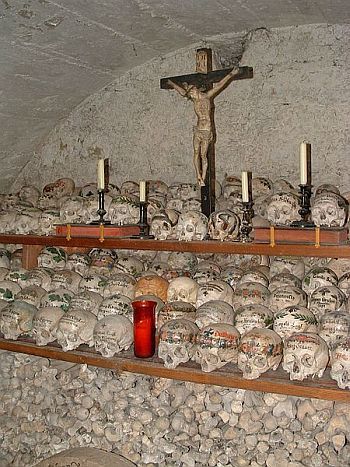
These ossuaries, or 'Karner' (from the Latin 'caro', meaning flesh), were found throughout Europe. The most famous example is the Karner in Hallstatt, where the tradition of painting is a notable feature. In a sense, this tradition is reminiscent of the decorated and embellished bones of saints, which were venerated as relics and displayed for the faithful and pilgrims. The aim was to show appreciation for the deceased. Once they had left the grave, it was no longer possible to honour or decorate their final resting place. Therefore, this was done directly on the bones of the deceased. This touching custom dispels any horror associated with the term 'ossuary', as an ossuary is simply a final resting place where families are reunited – decorated, inscribed and organised.
To us modern people, death is rather abstract. We do not perceive it as being part of life, as our ancestors probably did. This is why this type of commemoration may seem somewhat morbid to us, but it is by no means so. The Hallstatt Ossuary has a peaceful rather than eerie feel to it, bearing witness to loving remembrance. So far, around 2,100 skulls have been documented in this resting place, 600 of which have been preserved with paintings on them. Interestingly, different motifs were used at different times to decorate the skulls. The main motifs are flower wreaths, crosses and snakes in various designs, which vary in style depending on the period.
However, the Hallstatt Ossuary is not purely a museum, as it is possible to request that your own skull be kept there. Visitors learn that the most recently deposited skull was placed there in 1995. These are the remains of a woman who died in 1985 and requested this.
Apart from the interesting historical facts, a visit to the Hallstatt Ossuary is a memorable experience. After the first burial, a second burial took place around ten years later. Many years after the death of a loved one, memories of them probably come back to the forefront of people's minds.
Whether as a farewell, a reconciliation, or a way of moving on from grief, people's approach to death was different back then than it is in today's era of short-livedness. This could explain why we do not necessarily want to be reminded of our own mortality. However, this place could offer visitors an alternative perspective – namely, that death can represent a kind of hopeful love, as well as being irreversible.
© 'Death and Mourning: A visit to the Hallstatt Ossuary. An ossuary has a peaceful atmosphere rather than an eerie one': An article by Pressenet (translated by Izabel Comati), 01/2026. The image 'Ossuary in Hallstatt' shows a detail from a photograph by Gakuro, Creative Commons Licence
– Spinach is more than just a vegetarian energy booster!
– Friendships: Houses in our society (Essay)
– Shellac and the freedom of music!
Discover more articles! Use the search function:
English archive:
More reviews, book presentations and essays
2024/2025
German archive:
2025 |
2024 |
2023 |
2022 |
2021 |
2020 |
2019 |
2018 |
2017 |
2016 |
2015 |
2014 |
2013 |
2012 |
2011 |
2010 |
2009
Become a writer for Pressenet! Write articles for our online magazine on trending topics such as best books to read, health and wellness, technology and gadgets, business and finance, travel and tourism, lifestyle and fashion or education and career. Info: Become an author
Sponsors and investors are welcome: If you found our articles interesting, we would be grateful for a donation. Please also recommend us to your networks. Thank you very much!



Sitemap About Privacy Policy RSS Feed